Tuesday, May 24, 2022
Felicitating Prof. Hemachandra Reddy, Chairman, APSCHE and release of First Year B.A. first semester Political Science textbook @ Guntur
Thursday, May 19, 2022
Brainstorming Session on LSC & SDC on 19 May 2022
Expressing opinion at State Level Workshop/Brainstorm Session organised by CCE at GDC Mylavaram on Life Skill Courses and Skill Development Courses on 19 May 2022
Sunday, May 08, 2022
Monday, March 14, 2022
Tuesday, March 08, 2022
At Padmavathi Mahila Viswavidyalayam, Tirupati venue of National Conference on New Education Policy 2020 2 March 2022
Tuesday, July 06, 2021
Inauguration of First Year B.A. I Semester textbook by Hon'ble Chairman, Andhra Pradesh State Council of Higher Education (APSCHE), Prof K HemaChandra Reddy @ APSCHE, Mangalagiri
Wednesday, March 03, 2021
Academic visit to Sidharatha Mahila Kalashala, Vijayawada on 20.03.2021 along with Dr. P. Anil Kumar
Wednesday, December 30, 2020
Visit to Government Degree College for Women, Guntur as part of Autonomy Extension for the college.
Along with Principal Dr. Jyothsna Kumar, Vice-Chancellor Prof. Shashikala Wanjari, SNDT Women's University, Bombay and Dr. P. Anil Kumar, Academic Officer, O/o Commissionerate of Collegiate Education
Wednesday, May 13, 2020
Thursday, October 17, 2019
MUKTINATH TEMPLE
Muktinath is a Vishnu temple, sacred to both Hindus and Buddhists. It is located in Muktinath Valley at the foot of the Thorong La mountain pass in Mustang, Nepal. It is one of the world's highest temples (altitude 3,800 m). The site is close to the village of Ranipauwa, which is sometimes mistakenly called Muktinath.
Within Hinduism, it is known as Mukti Kshetra, which literally means the 'place of liberation' (moksh). This temple is considered to be 106th among the available 108 Divya Desam (premium temples) considered sacred by the Sri Vaishnava sect. Its ancient name in Sri Vaishnava literature.
The central shrine of Sri Muktinath is considered by Hindu Vaishnavas to be one of the eight most-sacred shrines, known as Svayam Vyakta Kshetras. The others are Srirangam, Srimushnam, Tirupati, Thotadri, Naimisharanya, Pushkar and Badrinath. The temple is small. The murti is gold and the size of a man.
The prakaram (outer courtyard) has 108 bull faces through which water is poured. The sacred water that flows in 108 pipes around the temple complex denotes the sacred Pushkarini waters (Temple Tanks) from the 108 Sri Vaishnava Divya Desams, where devotees take their sacred bath even in freezing temperatures.
Worship is conducted by Buddhists, with a Buddhist monk present. A local nun manages the pujas (prayer rituals) in the temple. Pilgrims are expected to offer a prasad (religious offering of food) to the deity.
The Tibetan Buddhist tradition states that Guru Rinpoche, also known as Padmasambhava, the founder of Tibetan Buddhism, meditated at Muktinath on his way to Tibet. This temple is praised by many saints of the Hindu tradition. Scripts narrating the temple's importance are available in Vishnu Purana with the Gandaki Mahathmya.
The waterway downstream from Muktinath along Kali Gandaki is the source of the Silas or Shaligrams that are required to establish a temple of Vishnu. It is considered to be one of the holiest places of pilgrimage for Hindus and Buddhists.
It has 108 water springs, a number that carries great significance in Hindu philosophy. As an example of the mystery surrounding the number 108, Hindu astrology mentions 12 zodiacs (or Rashi) and 9 planets (or Graha), giving a total of 108 combinations. 27 lunar mansions (or Nakshatras) are divided into four quarters (or Padas) each giving a combination of 108 Padas in total.
Hindu and Buddhist traditions claim this site to be the only place on Earth to host all five elements (fire, water, sky, earth and air) from which all material things in the universe are made. The riverbed of the Gandaki river has Shaligram stones that are used to worship Lord Vishnu. According to Sri Vaishnava philosophy, it is considered to be one of the most-sacred places of worship of Lord Vishnu.
It is said that one has to be gifted to get the darśan (divine presence). Lord Sri Vishnu murthi and Goddess Sri Devi and Bhoo Devi are believed to give Jeevan Mukthi, hence it is called Muktinath.
Monday, March 18, 2019
Attended International Conference on India - Vietnam Relations organised SEAP Studies, Sri Venkateswara University, Tirupati on 18.03.2019
Monday, June 25, 2018
Mystery of Sri Yantra Geoglyph in Oregon Dry Lake Bed
On 12th September, 1990 Boise TV station aired the story about the discovery of a giant pictograph about a quarter of a mile wide appearing in a dry lake bed east of Steens mountain, about 70 miles S.E. of Burns, Oregon in United States. The glyph had a machine like precision in its shape and clarity of lines and it was quickly identified as perfectly formed, the ancient Hindu meditation device ‘the Sri Yantra‘ identical in shape and proportion, and in its geometrical properties. This symbol was over a quarter of a mile in length, and consisted of 13.3 miles of lines, was scored into the hardpan at a depth of 3 inches and were 10 inches wide.
It was reported to have been discovered by Idaho Air National Guard’s pilot, Lt. Bill Miller, while on a flight on 10th August 1990. Interestingly, the skies above the Sri Yantra are regularly used as part of the Idaho Air National Guard’s pilot training area. There had been no trace of this formation. Neither had any of the other pilots of the Idaho National Guard observed any unusual activity or a design-in-process in this area. The etching simply appeared one morning.
![]() |
| Sri Yantra Geoglyph in Oregon Dry Lake Bed |
Two researchers, Don Newman and Alan Decker visited the site on September 15, 1990, and reported the symbol as being furrowed into the dry lake bed about 3 inches deep, noting that the area was noticeably missing any signs of tire tracks or foot prints even though their own tire tracks left 1/4 inch deep marks on the crusty surface of the dry lake bed.
The Sri Yantra design has a degree of complexity and a level of symmetry that makes it difficult to recreate its design even on paper, let alone furrow an enormous replication of it on a dry lake bed. The shape produced by the lines in this massive Sri Yantra at Oregon, could not be deciphered while standing on the ground. In fact, the shape only made sense when viewed from a height of a few thousand feet above. There was therefore a good deal of speculation that the glyph was not man-made. It is not visible today (Lat, Long: 42.738105,-118.314011), which fuels conspiracy theories about the aliens imprinting it in the sand and the military destroying it.
About forty days after the appearance of the glyph, a group of four people, headed by a Bill Witherspoon, claimed that they had etched out the pictograph, over a period of 10 days, by pulling a garden cultivator like a plow over the dry lake bed. He said that they chose the site for its beauty and remoteness. The design was made without modern machines or tools and they left the site on foot in order to keep the area vibrationally pure.
However, Bill and his group failed to offer in-progress proof of their ‘creativity’. When asked to demonstrate how they had gouged out 13.3 miles of lines, 3 inches deep and 10 inches wide, Bill Witherspoon’s team only managed to gouge out a ½ inch deep line with great exertion. The line lacked neatness, and, the displaced soil fell unevenly on the two sides of the carved line. No one believed anymore that the original glyph could have been created by using tools such as garden plows.
Bill Witherspoon spent the following couple of years monitoring the changes in the formation. In his article “Art as Technology: Oregon Desert Sri Yantra“, Bill claimed that as soon as they had finished the design the weather in the valley changed and Rain fell one hour after completion of design. Remarkably, the lightning and the rain were limited only to the small valley where we were working. The ranchers noticed a continued increase in the valley’s rainfall. This was accompanied by increased vegetative growth, as well as increased populations of several plants and three animals species that were not previously common in the valley. There was an increased feeling of harmony in the area and two years later, with the lines almost gone, the structure of the soil had changed. The soil changes were limited to the forty or so acres of the design and were most pronounced in its center. The overall result was increased rainfall and more organic matter.
Ancient Hindu Sri Yantra
The Sri Yantra also called Sri Chakra is a beautiful and complex sacred geometry used for worship, devotion and meditation. It has been in use for thousands of years and it’s origin seems unknown.
In Vedic texts, the Sri Yantra is defined as a device formed by nine interlocking triangles, with a perfect ratio of 3.14 or the divine number, Pi. It is composed of a square on the outside with four projections forming a T-shape structure, circles, a row of Lotus petals, and triangular forms inside the Lotus petals.
The Sri Yantra consists of a series of nine triangles superimposed around a small central circle known as Bindu (Point), forming forty-three Konas (or triangular projections). Four isosceles triangles with the apices upwards, representing Shiva or the Masculine. Five isosceles triangles with the apices downward, symbolizing female embodiment Shakti. Thus the Sri Yantra also represents the union of Masculine and Feminine Divine.
Every triangle is connected to the others by common points and this is the reason why it is so difficult to draw correctly. Changing the size or position of one triangle often require changing the position of many other triangles. There a many variations and many different methods to draw the Sri Yantra. Nobody seems to know what the original configuration is.
The Sri Yantra is variedly described as a visual representation of the sound ‘OM‘. It is thought that this ancient symbol was not intellectually constructed, but that it came to a Yogi in deep meditation as a representation of the primordial sound, OM. This symbol, along with sounds like OM have incredible healing powers if you just know how to use them correctly.
Hindu temples based on Sri Yantra formation
Its interesting to note that most of the temples and places of worship in ancient India and southeast Asia were built on the lines of Sri Yantra Meru formation. Even in places like Cambodia, Indonesia and Egypt which has ancient Indian influence the places of worship and pyramids were built on the lines of Sri Yantra.
- Courtesy
Mystery of India
Monday, December 25, 2017
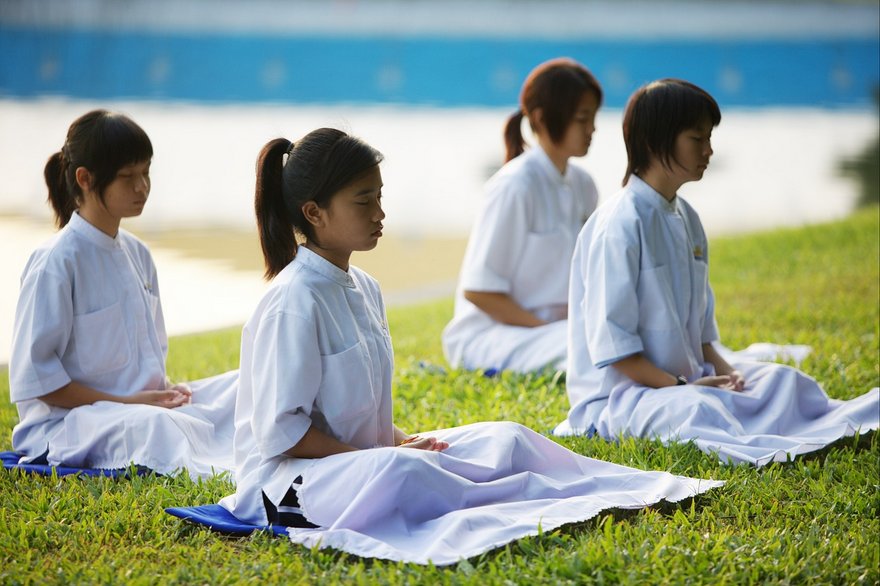
Vipassana: The Golden Silence

Vipassana meditation is an ancient technique, which the Buddha practiced on his journey to enlightenment. The objects of Vipassana meditation are thoughts, emotions and sensations throughout the body. When practiced with persistence, it can impact your life in a number of positive ways.
The key benefits of Vipassana meditation are as follows:
Development of Wisdom
A unique effect of Vipassana is it enables you to understand and experience the Law of Impermanence in action. This law states that everything is changing. Nothing lasts. This is true in our outer world. For instance, you buy a piece of clothing. Your wear it and wash it over again. All the time it is disintegrating.
The Law of Impermanence also applies to our inner world and our thoughts, feelings and sensations, which emerge, stay for a while and then pass away. By meditating on the arising and passing away of mind-body phenomena, one develops true wisdom of what is going on inside them.
Witness How Suffering is Caused
Related to the point above developing wisdom, by practicing Vipassana meditation, you also experience how you are responsible for your own suffering. When you become attached to your thoughts, emotions and feelings, you suffer. For instance if you have an unpleasant thought, you will resist it and become uncomfortable.
On the other hand, if you have a pleasant thought, you will enjoy it. However, it won’t last for long. As soon as it passes, there is potential for you to suffer again as you may become frustrated.
Non-Attachment
Through practice of Vipassana, you learnt to develop non-attachment to your thoughts, emotions and sensations. You know that whatever arises in you will pass away, anyway. By understand and experiencing this, you will become less and less attached to your mind-body phenomena.
You will learn how to stop creating a false Self, which happens through attachment. By meditating on non-attachment, over time you will experience reduced stress and become less agitated.
More Present Moment Living
By observing your thoughts, emotions and sensations objectively, you are living in the present moment, as you are not getting caught up in the contents of your mind-body phenomena. You’re just a detached observer. This is true living in the moment.
How to do Vipassana Meditation
When first starting out with Vipassana, aim to meditate for 20-30 minutes a day in one sitting. A basic outline for Vipassana meditation in the S.N. Goenka style is as follows.
1. Sit in a quiet place, cross-legged on a meditation cushion or a pillow. If it’s too uncomfortable to sit like this, you can also sit upright on a chair. Close your eyes.
2. Starting at the top of your head in the centre of it, observe sensations arising and passing away, objectively, without getting attached to them. These sensations could be prickling, tickling, heat or cold spots. If it’s a pleasant sensation, just observe it without labelling it as being pleasant. If it’s an unpleasant one, do the same.
Don’t react to it. Just observe it. Continue observing such sensations working your way down all over your body, your arms, chest, abdomen and your legs, until you reach the tips of your toes. Once you reach your toes, go back the other way from your toes to your head, observing sensations, arising and passing away.
3. As you’re observing sensations, if a thought or emotion arises in you, just observe it objectively, without becoming attached to it. For instance, if a pleasant emotion arises, don’t become attached it. On the other hand, if it is an unpleasant emotion arises, just observe it objectively. Maintain complete balance of your mind.
Source: hitenvyas.com
Five Health Benefits of Practicing Yoga
Yoga is a holistic exercise that some participants embrace both for its mental and physical benefits. Those hooked to the ancient practice of yoga enjoy a number of positive health effects, and, for some, those benefits lend to a healthier state of mind, too. B.K.S. Iyengar, the pioneer of what’s now known as the Iyengar style of yoga, once said, “Healthy plants and trees yield abundant flowers and fruits. Similarly, from a healthy person, smiles and happiness shine forth like the rays of the sun.”
Studies have shown that practicing yoga can promote good health in a number of ways. According to the National Center for Complementary and Integrative Health, yoga can help ease chronic lower back pain and improve range of motion in that area. What’s more, practicing yoga may help reduce blood pressure and lower heart rates, which can help with anxiety and depression.
“Other studies also suggest that practicing yoga (as well as other forms of regular exercise) might improve quality of life … and improve overall physical fitness, strength and flexibility,” the NCCIH reported. “But some research suggests yoga may not improve asthma, and studies looking at yoga and arthritis have had mixed results.”
And according to the American Osteopathic Association, there are more than 100 different schools of yoga to choose from, depending on if the end goal is a physical one or something more meditative.
1. Increased flexibility: Good flexibility is important in that it’s thought to increase physical performance and decrease the risk of exercise-related injuries, according to Mayo Clinic. Yoga Journal has you covered with a list of poses that can help increase flexibility.
2. Weight loss: Pointing to one study conducted at the Fred Hutchinson Cancer Research Center in Seattle, WebMD reported that yoga can help with weight loss — or at least help those who practice yoga not gain pounds — though it can take time for results to show.
According to the survey, which defined normal yoga practice as 30 minutes once a week for four plus years, weight loss over time is a real benefit for yogis. “Those practicing yoga who were overweight to start with lost about 5 pounds during the same time period those not practicing yoga gained 14 pounds,” Alan Kristal, a medical researcher who worked on the study, told WebMD.
3. Improved circulation: Certain yoga poses, particularly inversions or modified inversions — like legs up the wall pose — can help increase circulation in the body, which helps bring oxygen to vital organs throughout the body.
4. Stress reduction: According to Yoga Journal, there’s some serious biological processes at play to explain why practicing yoga can leave us feeling zen. The publication reports that yoga can help increase the activation of a body’s parasympathetic nervous system, which is the part of the autonomic nervous system that’s in charge of slowing a person’s heart rate and lowering blood pressure.
“Many yoga practices, including quiet asana, slow breathing, meditation and guided imagery, increase activation of the PNS and lead to mental relaxation,” Yoga Journal reported. “One of yoga’s secrets, documented in research from the Swami Vivekananda Yoga Research Foundation near Bangalore, is that more active practices followed by relaxing ones lead to deeper relaxation than relaxing practices alone.”
5. Muscle definition: Think of yoga as one long lifting session, if you were to replace the weights with the weight of your own body. Poses like plank position and chaturanga help to strengthen muscles in the arms and back, while chair pose helps tone leg muscles. Other poses, like triangle pose or tree pose, help build muscle by challenging the body’s balance.
“While this may seem like significantly less effort than hitting the gym and lifting barbells,” Livestrong stated, “a 2005 study by the American Council on Exercise found that participants could do significantly more pushups and situps — a sign of increased muscle mass — after eight weeks of Hatha yoga than those who did no exercise. This muscle strength translates visually over time into firm, sculpted bodies.”
Studies have shown that practicing yoga can promote good health in a number of ways. According to the National Center for Complementary and Integrative Health, yoga can help ease chronic lower back pain and improve range of motion in that area. What’s more, practicing yoga may help reduce blood pressure and lower heart rates, which can help with anxiety and depression.
“Other studies also suggest that practicing yoga (as well as other forms of regular exercise) might improve quality of life … and improve overall physical fitness, strength and flexibility,” the NCCIH reported. “But some research suggests yoga may not improve asthma, and studies looking at yoga and arthritis have had mixed results.”
And according to the American Osteopathic Association, there are more than 100 different schools of yoga to choose from, depending on if the end goal is a physical one or something more meditative.
1. Increased flexibility: Good flexibility is important in that it’s thought to increase physical performance and decrease the risk of exercise-related injuries, according to Mayo Clinic. Yoga Journal has you covered with a list of poses that can help increase flexibility.
2. Weight loss: Pointing to one study conducted at the Fred Hutchinson Cancer Research Center in Seattle, WebMD reported that yoga can help with weight loss — or at least help those who practice yoga not gain pounds — though it can take time for results to show.
According to the survey, which defined normal yoga practice as 30 minutes once a week for four plus years, weight loss over time is a real benefit for yogis. “Those practicing yoga who were overweight to start with lost about 5 pounds during the same time period those not practicing yoga gained 14 pounds,” Alan Kristal, a medical researcher who worked on the study, told WebMD.
3. Improved circulation: Certain yoga poses, particularly inversions or modified inversions — like legs up the wall pose — can help increase circulation in the body, which helps bring oxygen to vital organs throughout the body.
4. Stress reduction: According to Yoga Journal, there’s some serious biological processes at play to explain why practicing yoga can leave us feeling zen. The publication reports that yoga can help increase the activation of a body’s parasympathetic nervous system, which is the part of the autonomic nervous system that’s in charge of slowing a person’s heart rate and lowering blood pressure.
“Many yoga practices, including quiet asana, slow breathing, meditation and guided imagery, increase activation of the PNS and lead to mental relaxation,” Yoga Journal reported. “One of yoga’s secrets, documented in research from the Swami Vivekananda Yoga Research Foundation near Bangalore, is that more active practices followed by relaxing ones lead to deeper relaxation than relaxing practices alone.”
5. Muscle definition: Think of yoga as one long lifting session, if you were to replace the weights with the weight of your own body. Poses like plank position and chaturanga help to strengthen muscles in the arms and back, while chair pose helps tone leg muscles. Other poses, like triangle pose or tree pose, help build muscle by challenging the body’s balance.
“While this may seem like significantly less effort than hitting the gym and lifting barbells,” Livestrong stated, “a 2005 study by the American Council on Exercise found that participants could do significantly more pushups and situps — a sign of increased muscle mass — after eight weeks of Hatha yoga than those who did no exercise. This muscle strength translates visually over time into firm, sculpted bodies.”
Source: Yahoo News
Benefits of Bitter Gourd (Karela) Juice
Benefits of Bitter Gourd (Karela)Juice
Did you know that bitter
gourd or karela is not really a vegetable but a fruit? The part of the plant
that is used for consumption and for various medicinal purposes is the fruit of
the bitter squash. While we’ve been so busy condemning its bitter taste, we’ve
not only overlooked this fact but also the wide range of benefits that drinking
bitter gourd juice offers.
Bitter gourd juice contains
a train of important nutrients ranging from iron, magnesium and vitamin to
potassium and vitamin C. An excellent source of dietary fiber, it also contains
twice the calcium of spinach, beta-carotene of broccoli, and the potassium of a
banana. Here are some crucial benefits of drinking bitter gourd juice. A quick
tip to reduce the bitterness of the drink is to add some honey or jaggery to it
or pair it with sweet fruits like apple or pears. You can even add lemon juice
to lessen the harsh taste of bitter melon juice. A pinch of black pepper and
ginger can also decrease the tartness. The taste however, needs to be developed
because contrary to its name bitter gourd is in fact sweet for your health.
1. Helps in Maintaining Blood Sugar Levels
The World Health Organisation has estimated that
over 382 million people worldwide suffer from diabetes. Bitter gourd contains
an insulin-like compound called Polypeptide-p or p-insulin which has been shown
to control diabetes naturally. According to a 2011 study, published in the
Journal of Ethnopharmacolgy, a four-week clinical trial showed that 2,000 mg of
bitter melon when taken on regular basis reduced the blood glucose level
significantly in the patients suffering from type-2 diabetes. Studies have
shown that this plant-based insulin in bitter gourd helps patients with type-1
diabetes as well. Another report issued in the Journal of Chemistry &
Biology, gave evidence regarding the fact that bitter melon increases the
uptake of glucose and improves glycemic control. People suffering from diabetes
taking hypo-glycaemic drugs may even be required to alter the dosage of their
drugs if they consume bitter melon juice daily and consult a doctor before
doing so.
2. Lowers Bad
Cholesterol Levels
Bangalore-based
Nutritionist, Dr. Anju Sood, says, “Bitter gourd juice is anti-inflammatory and
also helps in lowering the bad cholesterol levels in the body. Thereby, it
significantly reduces the risk of heart attack and stroke.” It also maintains
the blood pressure of the body as it is rich in potassium, which absorbs
excessive sodium in the body. It is rich in iron and folic acid which are known
to decrease the risk of stroke and keep your heart healthy.
3.
Good for
Glowing Skin and Lustrous Hair
Longing for
that flawless skin? Dr. Simran Saini from Fortis Hospital in New Delhi suggests
that bitter gourd juice has powerful anti-oxidants along with vitamin A and C
which prevent premature skin ageing and diminishes wrinkles. Furthermore, it
reduces acne, aids in treating eczema and psoriasis, as well as protects the
skin from the harmful UV rays. The nutrients vitamin A, vitamin C, Biotin
and Zinc impart shine and lustre to your locks. Applying bitter gourd juice
regularly to your scalp can decrease hair loss and greying of hair, treat
split-ends and rough hair, shrug off dandruff, and combat itchiness. You can
apply bitter gourd juice directly to stop hair fall or mix it with some curd
and massage on your scalp and hair for conditioning. To treat dandruff, you can
make a hair mask with bitter gourd juice, cumin seed paste and a tablespoon of
lime juice. Leave for 30 minutes and rinse. Dr. Saini adds that the juice also
acts as a blood purifier.
4.
Cures
Hangovers and Cleanses the Liver
Bitter gourd
juice swiftly wipes out alcoholic intoxication settled in your liver. The juice
cleanses your bowel as well as heals many liver problems. Published in the
International Journal of Vitamin and Nutrition, a study concluded that a
compound called Momordica Charantia provides protection against liver failure
by strengthening anti-oxidant activity of the enzymes in the liver. It also
boosts the functioning of your bladder.
5.
Helps in
Weight Loss
Bitter gourd
is low in calories, fat and carbohydrates. It keeps you full for longer and
hence, it can easily fit in your weight loss plan. In a 2010 issue of a report
published in the Journal BMC Complementary and Alternative Medicine, it was
disclosed that extracts of bitter gourd helped in the dislocation of human fat
cells and also hindered the formation and growth of new fat cells. It was
further concluded that bitter gourd can be viewed as a natural agent for
treating obesity.
6.
Boosts Immune
System
Bitter gourd
fights viruses and bacteria and strengthens your immunity. It prevents
allergies and indigestion. The antioxidants work as powerful defense mechanisms
against illness and also help fight free-radical damage that can cause various
types of cancer. In 2010, a study was published in the Pharmaceutical Research
Journal which stated that bitter-melon has anti-carcinogen and anti-tumour
properties. It reduced the risk of prostate, breast and cervical cancer.
7. .Great for Eyes
Dr. Anshul Jai
Bharat says that it helps in preventing vision-related problems such as
cataract since it has compounds like beta-carotene and vitamin A which are
healthy for your eyes and strengthens eyesight. She adds, “It is also a good
home remedy to treat dark circles.
Subscribe to:
Posts (Atom)
The Strait of Hormuz
The 33-Kilometer Chokepoint: Why the World Can’t Outrun the Strait of Hormuz 1. Introduction: The Fragile Heart of Global Trade The Strai...
-
We should first take into account that ancient India, which was centered around the Indus Valley years ago, and was already well deve...
-
Donating IIT-JEE material to the Principal, Govt. Junior College, Anantapuramu.