Friday, March 11, 2016

How the World’s Oldest Science Can Help Us Heal in the Modern World

How the World’s Oldest Science Can Help Us Heal in the Modern World

Ayurveda is the oldest continuing health science in the world. The central principle of Ayurvedic science is that we are all unique with an individual constitution, and our own physical and psychological nature. Hence the Ayurvedic approach treats all aspects of a person, as anything that affects the mind will affect the body. The Sanskrit word Ayurveda, means the science or wisdom of life.
It is one of the few sciences that treats the individual through a thorough assessment of a persons unique makeup and circumstances. The individual is examined within the broader context of their life and all factors influencing their wellbeing are taken into consideration. The success of the Ayurvedic tradition comes through the promotion of balanced living and is founded on the principle that nothing functions in isolation.
While it is an ancient science from an ancient culture, in todays throwaway and quick fix culture, the perennial wisdom of seeing the individual as a whole and as part of his or environment, is fundamental to long term, sustainable wellbeing and happiness.
Ayurveda is a 5000-year-old philosophy based on a deep understanding about the human body as a whole, encompassing the mind, spirit, and emotions. It embraces medical science, philosophy, psychology as well as astrology and astronomy. Yoga and meditation, now widely embraced by westerners, are both key parts of Ayurveda. However, one does not need to subscribe to the spiritual beliefs on which it is based in order to benefit from it.
Ayurveda and the Modern World
In todays fast paced high-pressure modern world, stress and burnout are becoming an epidemic. In the US, nearly 80% of people experience physical symptoms caused by stress. Sleep deprivation, over exposure to media, financial pressures, poor nutrition, work pressures and relationship problems are all causing serious health issues. And too often people are turning to quick fixes, such as medication, instead of dealing with the underlying problems, so they unfortunately end up in a spiral of bad health and compromised wellbeing.
The three main goals of Ayurveda are to preserve the health of a healthy person, to prevent disease and to promote longevity through improved quality of life in mind, body and spirit. Health is defined as much more than just the absence of disease. One of the great scholars of Ayurveda defined health in this way:
Health is the state of equilibrium of doshas (biological humor), agnis (transformative physiological system functions), dhatus (tissues and organs), and malas (metabolic byproducts), along with sensorial, mental and spiritual well being. Sushruta
It is a sustainable system of healing that is available to all and works in harmony with the natural world. Ayurvedic healing tools are easily available herbs, oils and food. The central message of Ayurveda is: Let food be your medicine and kitchen be your first pharmacy.
Creating the Habits of Balanced Living
Ayurveda focuses on the art of balanced living, as nothing functions in isolation and imbalance often result in disorder and illness. Establishing a daily routine that create habits of self-care is seen as a sacred duty.
To create these habits, it helps to understand the fundamental elements of the complex system that is Ayurveda. The classical elements of Ether, Air, Fire, Water and Earth form the building blocks of all existence. The Ayurvedic belief is that the human body is made of the same elements as all of nature, and most peoples bodies express a predominance of one element. This results in a particular physical shape, appetite and personality that constitute ones dosha. The Doshas are different combinations of the five elements and their properties, and when in balance, maintains well-being. They are called Vata, Pitta and Kapha.
Vata Ether (or Space) and Air. Governs communication and movement. Thin, light body. Active and imaginative mind.
Pitta Fire and Water. Governs energy and transformation. Medium build, dynamic and intelligent.
Kapha Earth and Water. Governs structure and cohesion. Large or stocky body frame. Easygoing nature, stable and patient.

What’s Your Dosha?

Generally speaking, the dosha or doshas that are most dominant in your nature are the ones that cause you the most concern in your life. Consulting an Ayurvedic practitioner, or even taking an online questionnaire could help you determine what your Doshic state is. Many people have a fairly equal mix of two doshas present in their body type.

Our doshas are constantly in a state of flux and are influenced by our diet, lifestyle, the weather, our state of mind and our emotions. Due to these influences, you may have too much or too little of one or more doshas in your body-mind make up. Using the opposite qualities of the aggravated dosha can restore balance.

Lets use the example of Air. Say you exposed your body to excessive wind, you would become cold and your skin would become dry. The excess wind would have caused an imbalance of the air element, and we start to see the properties of air increase in a negative way. Therefore someone with a predominantly Vata (Air) dosha in an aggravated state could feel cold and have dry skin. Or they could be feeling bloated, spaced out, flighty and anxious, and talk very quickly. Fear affects the nervous system, and would increase the air element in the body and mind. Over time this imbalance of extra air (fear and worry) is likely to create coldness and dry skin.


The Elements

Using the elemental system, we could use opposing elements for balance. Eating warm, heavier, moist foods that are grounding (Kapha=Earth & Water) in nature. Steam saunas, or eating foods cooked with warming spices (Pitta=Fire & Water). Meditating and doing slow and calming yoga: all of this would help to balance the excess air and reduce the inclination toward fear and worry. In balance, a person with a lot of Vata dosha is enthusiastic, energetic, spontaneous, creative, flexible, quick thinking and open.

Like will increase like. A Vata dosha is dry, cold, light, rough and quick. Food that is cold, light dry and rough tends to increase Vata. Activities that increases Vata are running, high-energy exercise, and being constantly on the move.

The Pitta dosha is hot, intense, sharp and penetrating. Eating lots of hot, spicy, strong tasting, salty food increases Pitta. Activities that increase Pitta would involve a lot of sun and heat (like hot tubs or saunas).

The Kapha Dosha is cold, heavy, oily and soft. Eating food with these qualities, like dairy products or starchy food will increase Kapha. This dosha can be quite sedentary, so a lot of sleep and sitting still can increase Kapha.

The Healing Power of Herbs

Herbs play an essential role in this ancient system of healing. Many of the herbs used in Ayurveda (like tumeric) have made their way into Western homes with research proving their efficacy in treating many illnesses. Herbal teas and meals that balance your unique constitution are not only nourishing but also healing. As Hippocrates said: Let food be your medicine.

Eating well, using herbs that you can grow in your garden, honouring your body through yoga and abhyanga self massage and cultivating a quiet mind through meditation are all practical tools that help us to take ownership of our own health. When youre in balance, youre also more likely to maintain happy and satisfying relationships. Using the ancient wisdom of Ayurveda, we can create truly beneficial habits in our daily lives, or at the very least counterbalance those activities that may be having a negative effect on our wellbeing.

Kapha Earth and Water. Governs structure and cohesion. Large or stocky body frame. Easygoing nature, stable and patient.

Obesity Rises In A Country Where Millions Remain Malnourished

Obesity Rises In A Country Where Millions Remain Malnourished

India's increased obesity rate is linked to a rise in sedentary lifestyles and consumption of fast food.


The number of obese teenagers in India has almost doubled in the past five years, the country's health minister, Jagat Prakash Nadda, revealed Tuesday, according to The Associated Press.
Currently, 29 percent of Indians ages 13 to 18 are obese, compared to just 16 percent in 2010.
Nadda noted that the increased obesity rate is largely due to lifestyle changes that come with rising incomes. Indians are earning more and juggling more hectic work schedules, leading them to consume fast food because there's less time to prepare meals at home.
Studies that have appeared in journals such as the Indian Journal of Endocrinology and Metabolism and Ecology of Food and Nutrition have also blamed obesity rates on sedentary lifestyles that lead Indian citizens to spend more time indoors or sitting in cars, and not engaging in physical exercise outdoors.
Nadda also said there is an increasing number of Indians with diabetes, which is often associated with obesity. Over 69 million people out of the approximately 1.3 billion people in India -- or 5 percent of the population -- were registered with diabetes in 2015, compared to 66.8 million in 2014 and 65 million in 2013, Nadda said, citing statistics that have not yet been fully released to the public.
By comparison, over 29 million of the 319 million people in the United States have diabetes -- that's nine percent of the population. At least 32 million people in the European Union, or 6 percent of its population of 508 million, are also diabetic.

Yet India still has one of the highest hunger levels in the world. An estimated 194.6 million people in India are malnourished, the United Nations' 2015 State of Food Insecurity in the World report noted. Almost 30 percent of Indian children under age 5 are underweight, and 38 percent are stunted, according to a survey the U.N. and the Indian government conducted with 90,000 children between 2013 and 2014.
In fact, India's hunger levels ranked higher than in North Korea, Malawi and Iraq in the 2015 Global Hunger Index, which measured undernourishment and child wasting, stunting and mortality levels in 116 countries.
Poverty is a major cause of malnutrition in India. One-third of the country's population survives on less than $1.25 a day, per 2010 U.N. statistics, and in 2013, India's richest 10 percent held 30 percent of the country's income, while the poorest 10 percent held 3.5 percent, according to the World Bank.
Child malnutrition, in particular, can also be linked to poor sanitation. Many of the world's poor live in areas where a lack of sanitation facilities leads people to defecate in the open, causing bacteria to spread and affecting nutrition levels. The U.N.'s 2014 Millennium Development Goals Report noted that the majority of people who relieve themselves in the open live in populous countries like India.
Courtesy - Huffington Post

Saturday, March 05, 2016

Tulasi Mala

Importance of Wearing Tulasi Mala in Hinduism


Many religious-minded people throughout India and the rest of the world wear necklaces of Tulasi wood (tulasi kanthi mala). Tulasi wood is sacred to Lord Krishna and His followers. However, there are many popular taboos and misconceptions regarding who can and cannot wear tulasi.
This article will answer this question by citing the infallible authority of the Vedas. It is a fact that all actions, be they secular or spiritual, will be beneficial and successful when done in accordance with transcendental scriptures i.e. Shruti, Smrti and Puranas like Mahabharata and Bhagavad-gita.

Without being swayed by popular beliefs or opinions, Gaudiya Vaisnavas base their spiritual conduct on the authority of the Gaudiya Smrti titled Hari-bhakti vilasa by Srila Sanatana Goswamipada. This book is basically a collection of quotes from various Puranas and Vedas to establish the proper spiritual practices for adherents of the devotional path, bhakti-yoga. Quoting this pramana, we will describe the glories of wearing tulasi neckbeads and who can wear them.
Benefits of Wearing Tulasi Kanthi:
1. Destroys greatest of sins (maha pataka samhantrim) Skanda Purana: HBV: 4.3182.
2. Sri Hari is always with you (deha sada Harih) Garuda Purana: HBV 4.3353.
3. Million times benefit from punya karmas, pitr or devata puja (pitrnam devata krtam koti gunam) Garuda Purana: HBV: 4.3364.
4. Yamaraja stays far away (preta raja dutakah drstva nashyanti durena) Garuda Purana: HBV: 4.3375.
5. Gives full protection from bad dreams, accidents, attack by weapons, and the Yamaduttas (duhsvapnam durnimittam bhayam shastrajam) Garuda Purana: HBV: 4.338.
Who Can Wear Tulasi Neckbeads?
The following authoritative quotes should put to rest all rumors, taboos and speculations regarding this question. Bhagavan Sri Krishna Himself states that anyone can wear tulasi kanthi mala. There are no restrictions! The wearing of tulasi neckbeads, (tulasi kanthi mala) simply depends on one’s personal sense of allegiance to his beliefs, duty, or simply as a matter of inspiration if he/she wants to do so. Srila Sanatana Goswamipada calls this a taste or attraction to wear them, (yatha ruchi) HBV: 4.308.
In Vishnu Dharmottara, Bhagavan Sri Krishna says, “Without a doubt, anyonewho wears tulasi neckbeads, even if he/she is unclean or of bad character, will surely attain Me.” (ashauco anacharo mam eva iti na samshaya) HBV: 4.322.

The following quote from a book titled, Associates of Sri Chaitanya, says that Srila Bhaktivinoda Thakura gave tulasi neckbeads to a Calcutta industrialist who had neither diksha nor the most exemplary behavior: “Mr. S.K. Ghosh who often visited Srila Bhaktivinoda Thakura at his residence called “Bhakti Bhavana.” Under the direction of Srila Bhaktivinoda Thakura, Mr. Ghosh started wearing a tulasi mala around his neck, although he was not able to accept the principles of Vaishnava behavior in their entirety.”In addition, an Iskcon publication titled “Vaisnava Etiquette”, quoting Hari-bhakti Vilasa states: “The Padma Purana states regardless of whether one is an impure or pure state, one should always wear tulasi mala. And one should never take it off even when bathing, eating or passing stool and urine.” In other words, tulasi beads are always pure and purify anyone who contacts them.

UFOs – the Vedic Perspective

UFOs – the Vedic Perspective

The Vedas glorify our planet earth, as the most important planet in the cosmic system. She is celebrated for her infinite variegatedness in every aspect of her existence. She is the bearer and indispensable ground for sacrifices; the shelter for divine and human activities; the universal mother, feeding all with many beneficial things, and the one to whom every living being owes his existence. Man, in seeking to satisfy his needs and fulfil his goals, exerts his influence upon subtle elementary forces and gross fundamental powers. All material variations that exist on this planet are transformations of this earth.
According to Vedas, a fractional portion of the total cosmic energy is the individual lording identification (the tendency to want to control and exploit material nature). A portion of that ego is the vibration of sound, and a portion of that sound is atmospheric air. A portion of the airy atmosphere is turned into forms, and the forms constitute the power of electricity, or heat. Heat produces, smell, or aroma, which evolves into this gross earth. All these combine together and, governed by the law of inter-cooperation, constitutes the cosmic phenomenon.
Thus, the whole process of creation is an act of gradual evolution and development of one element to another. This results in the variegatedness of the earth: so many trees, plants, mountains, rivers, reptiles, birds, animals and varieties of human beings. The human form has the best design for interacting with matter, namely a perfect basis for sense perception. The quality of sense perception is also evolutionary, being generated from sound to touch to form to taste and smell. The different varieties of human bodies have similarly more progressive sense perceptions and powers of movement.
There are varieties of human life on this same earth, not accessible to us, sometimes on the same dimension, but mostly on higher dimensions. There are also human living beings on other planets, some in our dimension, many in higher.
Other planets in the higher planetary systems have not only different kinds of human beings, but also animals and plants. Some of these planets have lands made of precious jewels like emeralds. Geologists, botanists and so-called scientists speculate so much about life on this earth itself, but, unable to estimate the varieties of life both here and on the other planets, they falsely imagine that all other planets are vacant, uninhabited and full of dust. The Vedas make fun of such materialistic leaders who are praised by paid men who have the mentality of hogs, dogs, camels and asses. Such people, who simply accept knowledge imparted by big animals, will totally reject the UFO/ET phenomenon as null and void.
The Vedas say, “Manujah nivasah”, humanity is the residence of the Supreme. But in this material existence there is always the idea of lording it over the resources of material nature, which creates a clash between different living beings. There is, however, the universal law that brings about order out of chaos and creates harmony.
In the Vedic vision, man is an active part of the cosmic whole. Dynamic as he is, he does become a disturbing factor, but once guided towards perfection, he can play a vital role in the ultimate establishment of the supreme law in the manifested world.
The panorama of the world shows a conflict and a tension between polar opposite qualities, for which humans have always been the via medium. But there is also a movement in togetherness and a cooperation. There is a striving towards the light, towards unfolding the potential towards fuller life which is constitutional.
The divine law of the cosmos becomes, at the human level, particularized into specific regulations. Thus are developed those norms of social order which are meant to bring the best results for all concerned. Therefore is born civilization. The Vedas envision duty or “Dharma”, and function, or “Karma”. The cosmic order that brings about harmony is expressed in the aspect of qualities of duty such as mercy, austerity, truthfulness and cleanliness. There are reflected in the aspect of function as abstinence from meat-eating, intoxication, gambling and illicit sex.
By losing sight of that integration of human at peace with himself and the universe, gathering all faculties and powers in one central point from which to act in full, perfected consciousness, the self-centred humanity has only applied for dangerous disasters for our planet.
The activities of the physical world have their effect in their counterparts in the non-physical and especially subtle areas like the astral, ethereal, mental and vice versa.
Whimsical exploitation of the plant and animal kingdoms, and natural resources, over-indulgence in sense-gratification in all kinds of perverted ways — all these have led the human today to the criminal stand: the whole cosmic order is getting disturbed by our foolish endeavours to be the lords of all we survey. As a result of our crimes, Nature imposes upon us incurable diseases and frequent wars among nations.
That’s why our neighbours have started interfering with our lives. It is so that they can give us the message “Get back on track, man! Save the earth—now!”
Some of these aliens have also taken it on themselves to establish proper law and order on our area of the planet. It is the history in the Vedas that people of lower order cheaply endeavour to copy the higher, in spite of opposition and imperfections. This is part of the law governing their Psyche. They have gone so far that, in case we destroy the population on earth, they are making plans to repopulate the earth with good human beings. However, they themselves are a little bit over lording in this respect, because they are trying to accomplish this by harvesting samples of human sperm cells, ova and other vial fluids. This will further be discussed in our Workshop.
The subject of UFO, in many aspects, as far as the experience of many respectable common people, yogis and ascetics of India is concerned, is IFO. Identified, not unidentified. Even today, there are hundreds of ongoing visitations, channelled healings, and various kinds of what the modern scientist will term “paranormal phenomena”.
There is a great deal of information in the ancient Vedic texts on paranormal phenomena. Then 19th Century scholars, especially from colonial backgrounds, have always tried to explain every Vedic conception as based on an observable natural phenomenon, or on a particular sensory object. Whatever did not conform to their understanding was rejected as “mythology”, or “folklore”.
Another widespread tendency is to read into the Vedas esoteric implications based upon later usage of definite terms; yet another tendency is to interpret the descriptions symbolically and try to discern some indirect significance by means of sheer speculation and philosophical gymnastics. If one could scientifically take information from the Vedic literature, a lot of questions confronting us in the research of UFO/ET phenomenon can be answered.
An attempt in this direction is successfully accomplished by my friend Dr. Richard Thompson in his book “Alien Identities”, copies of which will be available at our booth and Workshop.
Representing an age-old tradition of the east, on behalf of the great seers and saints of the Vedic culture, we hereby appeal to the leading nation of the perceivable world on this planet, viz., the USA, to cast aside all doubts, sentimentality and suppression of truth and to begin now to scientifically research and study this undismissible UFO/ET phenomenon and make progress in the field of higher dimensional science. May peace and prosperity be with you! Om Tat Sat.
                                                                                        - courtesy 
IndiaDivine.org


Sunday, August 16, 2015

Andhra Patrika

A leading Telugu Daily published on 14.08.1947 about the Indian Independence Day

Saturday, August 08, 2015

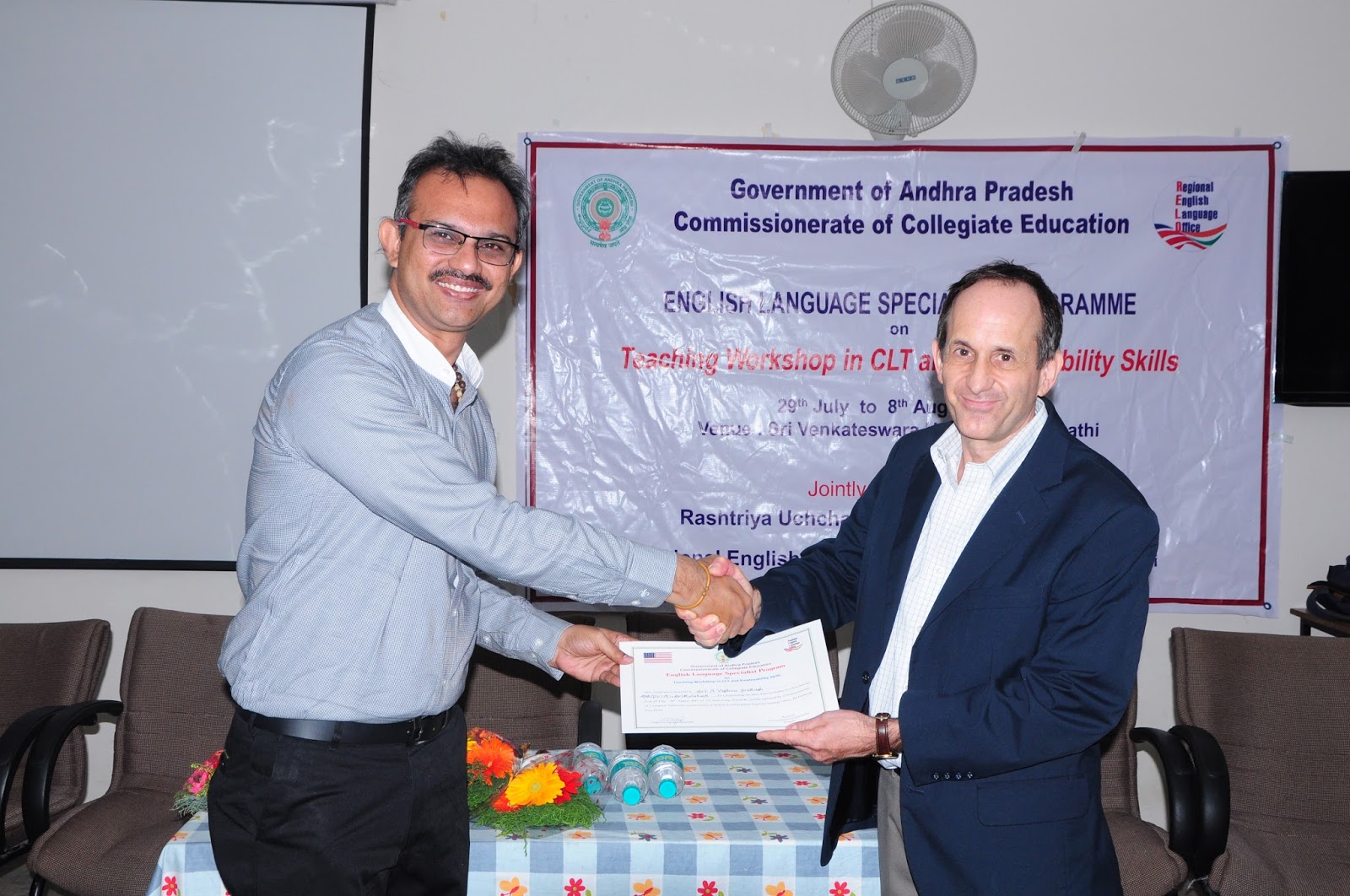
Certificate of Appreciation

 Receiving the Certificate of Appreciation from George Bishop Jr. English Language Specialist, USA for Coordinating the English Language Fellow Workshop at Sri Venkateswara University, Tirupati from 28th July, 2015 to 8th August, 2015, organised by Rashtriya Ucchetar Shiksha Abhiyaan (RUSA) and Regional English Office, US Embassy, New Delhi

Friday, April 24, 2015

Workshop on "Transforming Andhra Pradesh into Education & Knowledge Hub" at Centre for Innovations in Public Systems, Hyderabad

Got an opportunity to share some of  my ideas as a Executive Member in the State Knowledge Mission, Andhra Pradesh in a two day workshop on Knowledge Mission "Transforming Andhra Pradesh into Education & Knowledge Hub"  on 23 - 24 April, 2015 at Centre for Innovations in Public Systems (CIPS), Hyderabad.


Tuesday, March 10, 2015

Political Parties & Right to Information: The Indian Paradox

Presenting my observations as a Special Invitee during National Workshop 
"Political Parties & Right to Information: The Indian Paradox" .
Sharing the lighter moments with my friends

Thursday, February 26, 2015

Yuvatharangam - 2014

Yuvatharangam - 2014 

Receiving Memento in Chittoor in Yuvatharangam - 2014

Be Yourself

Be Yourself

"There is a time in every man's life education when he arrives at the conviction that envy is ignorance; that imitation is suicide; that he must take himself for better, for worse, as his portion; that though the wide universe is full of good, no kernel of nourishing corn can come to him which is given him to till. the power which resides in him is new in nature, and none but he knows what that is which he can do, nor does he know until he has tried".


Let's not imitate others. Let's find ourselves and be ourselves.

Friday, February 20, 2015

Workshop on "National Integration: Challenges & Remedies"

Receiving felicitation from my Research Supervisor Prof.B.V.Muralidhar, Head, Dept. of Political Science & Public Administration, S.V. University, Tirupati, Smt. Meharunissa, Principal, Dr.Sreeramulu, Vice-Principal, Dr.Ramana Reddy and Organizing Secretary Dr.Bhasker Raju for delivering a Special Invitee Address during the UGC sponsored National Workshop at Puttur, Chittoor on "National Integration: Challenges & Remedies"

Saturday, January 31, 2015

Electoral Reforms:Need of the Hour - National Conference

Photo Collage

U.G.C. Sponsored National Conference 
on 
"Electoral Reforms: Need of the Hour" 
 31.01.2015

Guard of Honour to Prof.W.Rajendra, Vice- Chancellor,  Sri Venkateswara University

Lighting of the lamp
Inaugural speech by the organizer 

Presidential Speech by Dr.Saraswathy Rajagopal, Principal of SVA Govt. College
Inaugural Keynote Address by Prof. B.Krishna Murthy, Registrar, VELS University, Chennai
Presenting memento to the Chief Guests

Group photo with the Guests
Presenting memento to Prof. Devarajulu, Registrar S.V. University
Valedictory Keynote Address by Prof. M.Uma, University of Mysore
    

Saturday, December 06, 2014

INTER-UNIVERSITY FACULTY FORUM STATE AWARD

Receiving Yuvatharangam 2014 Inter-University Faculty Forum State Award in Political Science from the Principal Secretary Higher Education Smt. Neelam Sahani, I.A.S. and the Commissioner, Collegiate Eduation, Smt. Sunita, I.A.S. for contributions made to the Research in Political Science.

Yuvatharangam 2014 Inter University State Award

Receiving the Yuvatharangam 2014 Inter-University State Award for Political Science from Smt. Neelam Sahani, I.A.S. and Smt. K. Sunita, I.A.S.,Commissioner, Collegiate Education, Andhra Pradesh. To the extreme is Prof.Venu Gopal Reddy, Chairman, Andhra Pradesh State Higher Education Council.

Saturday, October 25, 2014

The Strait of Hormuz

  The 33-Kilometer Chokepoint:  Why the World Can’t Outrun the Strait of Hormuz 1. Introduction: The Fragile Heart of Global Trade The Strai...